AI Engineer · Trustworthy & Generative AI

Ahmed Moubarak Lahlyal

AI Engineer · Data Foundations

Trustworthy AI · Generative AI · Data Engineering

>

I build intelligent systems from data to deployment — with security, traceability and measurable performance in mind.

LLMs RAG / Graph-RAG Knowledge Graphs Agentic AI Machine Learning Data Engineering Secure AI
Explore My AI Projects Ask My AI Assistant
Engineering Graduate · 2026 — Computer Science & Emerging Technologies, ENSA El Jadida Advanced Master® Data & Generative AI Engineering · EFREI Paris Apprenticeship: 2 weeks company / 1 week school
Portrait of Ahmed Moubarak Lahlyal
scroll ↓ · press ▶ to present
02 · Who I Am

The profile behind the systems

I am an AI Engineer with a strong Data Engineering foundation and hands-on experience in Machine Learning, Generative AI, Knowledge Graphs, multimodal systems and trustworthy AI. My work spans the complete AI lifecycle — data preparation, model development, retrieval systems, agent orchestration, APIs, security mechanisms, evaluation and deployment. I particularly enjoy problems where AI must operate under real engineering constraints: reliability, traceability, security, performance and maintainability.

01 —

AI Engineering

From ML experimentation to LLM-based applications, agents and APIs.

02 —

Data Foundations

Pipelines, SQL, Big Data, Knowledge Graphs and heterogeneous data.

03 —

Trustworthy Systems

Security, controlled retrieval, evaluation, traceability and governance.

I enjoy working at the intersection of research, engineering and real-world constraints.
03 · Professional & R&D Experience

Where I worked, and what I built

Four experiences with exact dates — the project, the problem, my contribution, the stack and the result. Each links to the full project.

Feb 2026 → Jul 2026
LISTIC Laboratory
Université Savoie Mont Blanc / Polytech Annecy-Chambéry
Annecy, France
Final-Year R&D Internship — Secure Document AI, LLMs & Agentic Security
SecureDocAI

How can an organization use LLMs over sensitive documents without giving every user access to everything?

What I worked on
  • Document ingestion & OCR / native PDF parsing
  • Information extraction → canonical JSON
  • PII / PHI detection & protected storage
  • Vector index + Knowledge Graph, RAG / Graph-RAG
  • Agent orchestration, RBAC, prompt-injection & jailbreak filtering
  • Secure retrieval, output validation, risk classification
  • FastAPI services, Docker, evaluation & scientific writing
My contribution

I designed and implemented major parts of the end-to-end system as part of the LISTIC research team — from document processing and knowledge retrieval to security mechanisms, LLM orchestration and experimental evaluation.

Technologies
PythonFastAPILangGraphCrewAILangChainRAGGraph-RAGNeo4jChromaDBPresidioSBERTXGBoostOCRDocker
97.8% RBAC compliance · unauthorized leakage 15.39% → 0.21% — full metrics in the SecureDocAI section.

Takeaway — For sensitive AI, access control, provenance and output validation cannot be afterthoughts.

Explore SecureDocAI →

Jul 2025 → Oct 2025
Mohammed VI Polytechnic University (UM6P)
Smart Data Analysis Systems Research Group
Morocco
Research Internship — Multimodal Deep Learning for EEG + IMU Classification
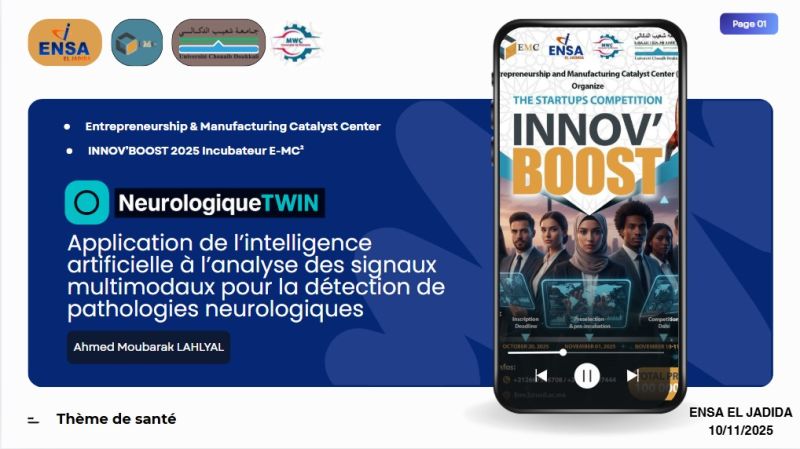
NeurologiqueTWIN

How can EEG and IMU time-series be classified with Deep Learning to support neurological monitoring?

Core internship work
  • EEG + IMU preprocessing
  • Temporal synchronization
  • Segmentation / windowing
  • Deep-learning models (CNN + attention)
  • Multimodal time-series classification
My extension — Digital Twin
  • Monitoring interface
  • Visualization of model outputs
  • Digital-Twin layer
My contribution

The core of the internship was multimodal Deep Learning: I processed and synchronized EEG/IMU signals, segmented the time-series and developed the deep-learning classification models. I then extended the project with a Digital-Twin layer to monitor and visualize the classification outputs over time.

Technologies
PythonPyTorchTensorFlowscikit-learnPandasNumPyCNNAttentionEEGIMUStreamlit
≈92% internal classification accuracy · 6–10 pp improvement in pre-crisis recall.

Takeaway — In multimodal AI, signal quality and temporal synchronization can matter as much as model complexity. The Digital-Twin extension connected model predictions with an interactive monitoring layer.

Explore NeurologiqueTWIN →
May 2025 → Jul 2025
AQUADVISER
Data Science Internship
Data Science Internship — Graph-RAG & Knowledge Graphs
Graph-RAG Decision Support

How can business information be retrieved using both semantic similarity and the explicit relationships between entities?

What I worked on
  • Data ingestion & cleaning
  • Entity & relationship modelling
  • Neo4j knowledge graph construction
  • Vector embeddings & semantic search
  • Graph traversal & hybrid retrieval
  • LLM integration (RAG / Graph-RAG)
  • FastAPI, provenance & traceability, architecture documentation
My contribution

Developed a Graph-RAG architecture combining semantic vector retrieval with knowledge-graph relationships to produce more contextual and traceable decision-support responses.

Technologies
PythonFastAPINeo4jEmbeddingsVector SearchSQLLLMsRAGGraph-RAG
Grounded, source-attributed answers that use both similarity and explicit relationships.

Takeaway — Vector similarity and explicit graph relationships solve different retrieval problems and can complement each other.

Explore Graph-RAG Decision Support →
Jul 2024 → Aug 2024
OCP Group
Software Development & Data Analytics Internship
Morocco
Software Development & Data Analytics Internship — the data foundation
Survey & Analytics Platform

Transform collected business information into structured data, operational indicators and decision-support reporting.

What I worked on
  • Web application development
  • Data collection
  • SQL database design
  • Data analysis & KPIs
  • Operational reporting & dashboards
  • Data visualization
My contribution

Developed a web-based survey and analytics platform connected to a SQL database and created operational indicators and reporting views.

Technologies
SQLWeb DevelopmentData VisualizationKPI DesignReporting
A working survey → SQL → KPI reporting platform.

Takeaway — This experience gave me the data and software foundations that later supported my Machine Learning and AI projects.

Explore Survey & Analytics Platform →
04 · Research & Publications

A research profile, not only projects

One peer-reviewed publication, one manuscript in preparation, and a clear research direction — from knowledge representation to trustworthy generative AI.

PUBLISHED · PEER-REVIEWED

CityEcoScout

A Platform for Exploring Sustainable Locations Worldwide

Co-authored an AI-enabled platform for exploring sustainable urban locations, combining geographic services (Google Maps, Street View, Places APIs), environmental analytics and generative AI (Gemini).

IJCEDS · Vol. 4, Issue 1 · 2025 · pp. 41–54
Benhirt · Fihri · Lahlyal (co-author) · Errattahi
Sustainable AIGeospatial DataGenerative AISmart CitiesEnvironmental Analytics
Read Publication ↗
MANUSCRIPT IN PREPARATION

SecureDocAI

Trustworthy Document AI & Secure LLM-Based Information Access

Research on secure document intelligence and controlled LLM-based access for sensitive multi-domain documents — Document AI, RAG, Knowledge Graphs, role-aware retrieval, adversarial filtering and output governance.

LISTIC · Université Savoie Mont Blanc / Polytech Annecy-Chambéry
Faiza Loukil · Hervé Verjus · Ahmed Moubarak Lahlyal
Trustworthy AIDocument AILLMsRAG / Graph-RAGKnowledge GraphsAI SecurityPrompt-Injection DefenseAccess ControlAgentic AI
Verified results — 6,000 scenarios · 97.8% RBAC · leakage 15.39% → 0.21% · 95% utility · 0.96 PII/PHI F1 · 0.98 ROC-AUC

Research interests

Trustworthy Generative AISecure RAGAgentic AIKnowledge GraphsMultimodal LearningPredictive ModelingDocument IntelligenceDigital TwinsIndustrial AIAI SecurityHuman-in-the-Loop AIModel Evaluation

My research interests focus on AI systems that combine strong predictive or generative capabilities with security, traceability, evaluation and real-world engineering constraints.

05 ◆ FLAGSHIP PROJECT · MANUSCRIPT IN PREPARATION

SecureDocAI

From Document Intelligence to Trustworthy Generative AI

The Problem

How can an organization use LLMs over sensitive documents without giving every user access to every piece of information?

1

A company has sensitive documents — financial, administrative, legal, clinical.

2

The system reads and structures the documents.

3

Specialized AI components each handle a different task.

4

On a question it checks who is asking, what they may access, and whether the request is suspicious.

5

Only authorized information is retrieved.

6

The LLM receives only the minimum context needed.

7

The generated answer is checked again.

8

The user receives a controlled answer.

The system as specialized AI workers (multi-agent)
Document Agent

Reads and structures the document.

Extraction Agent

Identifies useful information.

Retrieval Agent

Finds relevant knowledge.

Security / Policy

Checks what is authorized.

LLM / Answer Agent

Answers using the controlled context.

Validation

Checks the final answer.

The goal is simple: give the right information to the right user, without exposing sensitive information. Agents are not independent robots — they are specialized software components coordinated through a controlled workflow.
500
Documents
6,000
Evaluation scenarios
97.8%
RBAC compliance
0.21%
Final unauthorized leakage
95%
Authorized utility
15.39%0.21%
Unauthorized leakage
98.6%
Relative leakage reduction
0.96
PII / PHI micro-F1
0.98
Risk classifier ROC-AUC
Security without utility is not enough. The objective was to reduce unauthorized disclosure while preserving useful answers for authorized users.
Architecture designDocument-processing pipelineRAG / Graph-RAG integration Security mechanismsRBACPrompt-injection filtering Sensitive-data protectionAgent orchestrationFastAPI services Evaluation protocolExperimental analysisTechnical documentation Scientific manuscript contribution

I designed and implemented major parts of the system as part of the LISTIC research team.

06 · Selected AI Systems

Systems, not slides

Each project is framed the same way — Problem, What I built, My contribution, Technical approach, Results, Takeaway — with a live visualization of how it actually works.

SecureDocAI ↑flagship · see section 06
NeurologiqueTWIN
Question Understand SQL Generation Consistency KPI + Viz Execution Answer
Trade-off — smaller student vs teacher Quality Latency Memory Energy
CV Recommended offers TF-IDF + SBERT · cosine similarity Skills Experience Keywords TF-IDF+SBERT Offer · 0.91 Offer · 0.78 Offer · 0.64
Kafka Spark Streaming ETL / ELT NoSQL
Deep Learning · Multimodal Time Series (+ Digital Twin) · UM6P — 2025

NeurologiqueTWIN

ProblemClassify heterogeneous physiological time-series (EEG + IMU) with deep learning for neurological monitoring.
Core internship workA multimodal deep-learning classification pipeline: EEG/IMU preprocessing, temporal synchronization, segmentation/windowing and a CNN + attention classifier.
My extensionA Digital-Twin layer to monitor, visualize and interact with the classification outputs over time.
Technical approachPython · PyTorch · TensorFlow · CNN · Attention · EEG / IMU · Streamlit
Results≈92% internal classification accuracy; 6–10 pp pre-crisis recall improvement.
≈92%internal classification accuracy
Takeaway — In multimodal AI, signal quality and temporal synchronization can matter as much as model complexity.

07 · Hackathons & Awards

Building under pressure

A 2nd-place innovation award and two focused hackathons — evidence of fast prototyping and delivery.

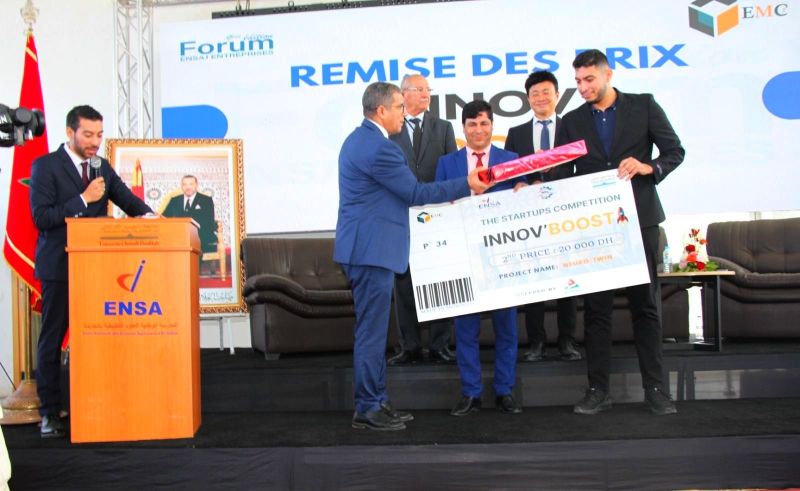
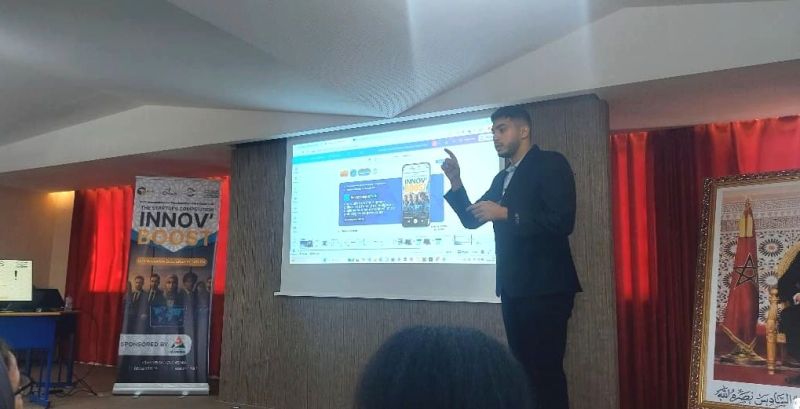
🏆 2ND PRIZE · INNOV'BOOST 2025

NeurologiqueTWIN

The Startups Competition, Forum ENSAJ Entreprises (ENSA El Jadida) — multimodal EEG + IMU AI for neurological monitoring.

Open Data Hackathon 2025 · Digital Health

Santeo

An application combining open data and AI agents to improve access to healthcare services.

Pwned Hackathon · Cybersecurity & AI

Security & rapid prototyping

Security analysis and rapid prototyping / development under time constraints.

08 · Engineering Mindset

How I think as an AI Engineer

The part that matters most for critical systems: not which framework, but how decisions are made.

01

Problem before technology

Start from the use case, constraints and measurable objective.

02

Baseline before complexity

A simple, measurable baseline before agents, graphs or larger models.

03

Measure before claiming

No result is real until it is quantified on a defined protocol.

04

Security by design

Access control, provenance and output validation are not afterthoughts.

05

Traceability matters

Every answer should be explainable back to its source.

06

Human oversight for critical decisions

The more critical the decision, the stronger the validation.

07

Build for maintainability

Modular, documented systems others can extend safely.

I don't use AI because it is fashionable. I use it when it provides measurable value.
I see AI engineering as a complete system problem: data, models, software, security, evaluation and deployment.
09 · Why Thales

Where my work points

An honest overlap between what I have been building and what I want to explore next.

What I have been building

Trustworthy Generative AISecure RAGKnowledge GraphsAI AgentsData EngineeringMultimodal AIEvaluationTraceability
THALES

What I want to explore further

AI for critical systemsRobustnessReliabilityExplainabilityCybersecurityIndustrial validationHuman-AI collaborationDeployment under strong constraints

What attracts me is the opportunity to work on AI where performance alone is not enough — reliability, security, traceability and human control also matter.

I want to understand how advanced AI research becomes a dependable capability in real industrial and critical systems.

A question I'd like to ask you

What technical problem would you want me to work on first?

Why me?

1

End-to-end AI perspective

Data → Models → APIs → Security → Deployment.

2

Research + Engineering

Defining experiments and implementing working systems.

3

Trustworthy AI experience

Access control, adversarial requests, sensitive data, LLM governance.

4

Fast learning across domains

Industrial data, Knowledge Graphs, Multimodal AI, Generative AI.

5

Explaining technical systems

Architecture, documentation, scientific writing, presentations.

Curious enough to explore. Rigorous enough to measure. Pragmatic enough to simplify.
10 · AI Assistant

Ask Ahmed's AI

Profile-grounded AI — an assistant grounded in my complete profile: research & publications, projects, skills, experience and engineering approach. Intent-aware retrieval over one verified profile, answered by Llama 3.2 when running locally, or a curated profile mode on the web. It never redirects everything to one project.

AI
Ahmed AI
Grounded in Ahmed's portfolio
connecting…

Ask Me — talking points

Interview questions I can answer orally. Click to reveal concise points (not auto-answered).

11 · Technical Foundations

Organized by architecture layer

Not a logo wall. Tools are not the goal — architecture and measurable value are.

AI & Machine Learning

PythonPyTorchTensorFlowscikit-learnXGBoostDeep LearningCNNsAttentionClassificationForecastingAnomaly DetectionModel Evaluation

Generative AI & NLP

LLMsRAGGraph-RAGLangGraphCrewAILangChainHugging FaceSBERTEmbeddingsNERPrompt EngineeringAgentic WorkflowsGuardrailsPrompt-Injection Defense

Document AI & Vision

OCRPDF ParsingLayout AnalysisInformation ExtractionTesseractDocTRMistral OCRPDFPlumberLayoutLMv3OpenCV

Data Engineering

SQLETL / ELTKafkaSparkSpark StreamingHadoopHDFSHiveHBaseAirflowTalendData Pipelines

Databases & Knowledge Systems

PostgreSQLSQL ServerMySQLMongoDBCassandraNeo4jChromaDBKnowledge GraphsVector Databases

Software Engineering & MLOps

FastAPIREST APIsDockerGit / GitHubLinuxTestingLoggingModular ArchitectureCI/CD fundamentals

Business Intelligence

Power BIDAXPower QueryTableauSupersetLooker StudioKPI DesignData Visualization
12 · How I Work

Soft skills, as behaviors

Not a list of adjectives — how I actually work on technical problems and in a team.

Curiosity

I like understanding systems beyond the surface.

Analytical thinking

I break complex problems into measurable components.

Rigor

I value reproducible experiments, testing and documentation.

Autonomy

I investigate and prototype independently, while knowing when expert feedback is needed.

Communication & teamwork

I explain technical decisions clearly and collaborate around feedback and shared objectives.

Adaptability

I have worked across Data Analytics, Knowledge Graphs, Deep Learning, Generative AI and secure AI systems.

Engineering pragmatism — I prefer the simplest architecture that reliably solves the problem, and add complexity only when it provides measurable value.
13 · Education & Certifications

Education & credentials

June 2026

Engineering Degree — Computer Science & Emerging Technologies

ENSA El Jadida.

2026 → 2027

Advanced Master® — Data & Generative AI Engineering

EFREI Paris. Apprenticeship: 2 weeks company / 1 week school.

Plus verifiable certifications in cloud, data and Python.

Languages

Arabic — native / bilingual French — C1 English — C1
14 · Let's Talk

Let's build AI that can be trusted.

Ahmed Moubarak Lahlyal · AI & Data Engineer

Advanced Master® — Data & Generative AI Engineering · EFREI Paris

Apprenticeship: 2 weeks company / 1 week school

To ask the team

Could you tell me more about the AI project and its main technical challenges?

To ask the team

How do you validate AI systems when reliability and security are critical?

To ask the team

What would you expect an apprentice to accomplish during the first three to six months?

Thank you for the discussion.

01 / 09
Presenter notes